WARNING for European visitors: European Union laws require you to give European Union visitors information about cookies used on your blog. In many cases, these laws also require you to obtain consent. As a courtesy, we have added a notice on your blog to explain Google's use of certain Blogger and Google cookies, including use of Google Analytics and AdSense cookies. You are responsible for confirming this notice actually works for your blog, and that it displays. If you employ other cookies, for example by adding third party features, this notice may not work for you. Learn more about this notice and your responsibilities.
downwithtyranny Guardian poll doesn't show Obama getting another Nobel Peace Prize. #1 contender is an American though, a deserving one http://bit.ly/ozlzaS
Uncovering or fabricating dirt on people is an old tactic. It can and should be countered, by bloggers the instant they start seeing it. If you are following the MSM coverage and you see them start quoting dirt about the history of the leaders or people quoted make sure they are accurate and in context and then demand factual corrections.
Eight years of war in Iraq succeeded in transforming the country’s oil industry from a nationalized model, largely closed to American oil companies, into an all but privatized industry open to foreign oil companies. ExxonMobil and BP, among other companies, are today producing oil in Iraq for the first time in over 30 years under some of the most corporate-friendly terms in the world. However, opposition from Kurdish leaders, Iraqi unions, civil society organizations, and some parliamentarians — who worry that the terms would grant undue benefit to foreign companies, to the detriment of Iraq’s economic stability and security — has kept the Iraq Oil and Gas Law, written to lock in this access, from passage.
But while the effort to transform Iraq’s oil sector has played out on a fairly public international stage, no such attention has been focused on Afghanistan. Compared to Iraq, Afghanistan’s populace remains poorly educated, its civil society and public sector workforce underdeveloped, and its government not only weak and challenged by corruption, but also lacking in both energy sector expertise and infrastructure. Under such circumstances, a radical redesign of the nation’s energy development model cannot take place in a manner that ensures fairness, equity, sustainability, or safety.
The Athabasca River drains an area of approximately 138,000 km², and flows nearly 1,400 km from its headwaters to the Peace-Athabasca Delta and Lake Athabasca. The Athabasca River system includes a total of 94 rivers, over 150 named creeks, numerous unnamed creeks, and 153 lakes (Science Outreach 2007).
The Regional Aquatics Monitoring Program (RAMP) website provides access to a wide range of information related to the program. RAMP is an industry-funded, multi-stakeholder environmental monitoring program initiated in 1997. The intent of RAMP is to integrate aquatic monitoring activities across different components of the aquatic environment, different geographical locations, and Athabasca oils sands and other developments in the Athabasca oil sands region so that long-term trends, regional issues and potential cumulative effects related to oil sands and other development can be identified and addressed.
The provincial and federal governments have been in dereliction of their duties, to the Albertan people impacted by this development, both from an environmental and a social economic standpoint.
In forty years two acres of Tar Sands mining area has been reclaimed to the levels the Alberta government will certify. For comparison the area of Alberta affected by the Tar Sands, is slightly larger than the country of Greece.
The facts are clear, human health is being compromised, water is being polluted, the environment devastated, the land cannot be restored, and the new Land Use Framework, which is being developed to mitigate the cumulative negative effects of development on the land and thereby the people of Alberta is in direct violation of treaty rights. The federal, provincial, and municipal governments lack the political will to take action on these issues. Thereby the Keepers of the Athabasca resolve to work in coalition with others along the watershed to promote and uphold indigenous rights, promote continued awareness and inspire the public to take action to hold our government responsible." Image via Wikipedia Interesting Science Links
Last week, we wrote about the remarkable paper in Science where a dozen scientists called for a ban on mountaintop removal mining due to the practice's harmful effects on the environment and on human health. There's an even greater environmental crime being perpetrated north of the border, but at least for the moment the semi-equivalent scientists aren't showing quite as much spine.
A much less publicized paper and accompanying commentary (PDF, sub's required) were recently released in the Proceedings of the National Academy of Sciences on the high concentrations of various toxic chemical compounds found in the Athabasca River in Alberta as a result of enormous tar sands mining operations. Let's focus on the commentary, as there isn't much point in writing a commentary on someone else's research unless you have something to say. Right? Well, these particular scientists, while clearly aware of the damage being done to the region as dirty bitumen is pulled from the ground, don't call for a ban on anything:
"Currently, the majority of bitumen is recovered by surface-mining practices that require the clearing of large areas of land, resulting in loss of habitat, including migration corridors and breeding grounds for terrestrial and aquatic species. Methods for mitigating and remediating these effects are under development, but even when remediated the habitat will be considerably different from its previous state. These externalities are costs that should be considered when developing this resource."
Pragmatic Advocacy, or Something
The three authors of the commentary go on to discuss the billion-plus cubic feet of "oil sands process water" (read: really dirty liquid that you wouldn't want to stand near let alone drink) in the tailings ponds in the Athabasca region, and the extremely high concentrations of damaging things like polycyclic aromatic hydrocarbons that appear to be finding their way into the ecosystem. The authors conclude:
"Global demand for oil and the resulting economic potential mean that development of oil sands will continue. This development has the potential to impact society and the environment significantly. It is essential that any detrimental effects be mitigated as much as possible and that development proceed in a manner that minimizes effects on the health and welfare of the environment, wildlife, and humans like."
One could see this as pragmatic, I suppose. Yes, tar sands development—right, sorry—OIL sands development is certainly likely to continue in the foreseeable future. But I'm not sure why one can't be pragmatic and idealistic at the same time.
In the Science paper, the authors asserted that "Regulators should no longer ignorerigorous science." Also, “Mining permits are being issued despite the preponderance ofscientific evidence that impacts are pervasive and irreversibleand that mitigation cannot compensate for losses." The contrast between the two is striking.
Two things remain important to remember.
First, Central Appalachian coal production is headed toward a major, major decline — with or without additional restrictions on mountaintop removal (or greenhouse gases rules for that matter). So whatever surface mining’s economic benefits to the region, policymakers need to get ready for those benefits to begin to evaporate.
Second, the industry just can’t argue with a straight face that mountaintop removal isn’t having negative impacts on the environment in Appalachia. The science that says otherwise is too overwhelming to ignore. Undoubtedly, the two new EPA studies released yesterday (see here and here) will only add to that science.
( Like Appalachia, Alberta will end up 'holding the bag' )
But What Is To Be Done? (a recurring theme) Worth a read in its entirety is this practical, well-informed piece by Maude Barlow.
For too long environmentalists have toiled in isolation from those communities and groups working for human and social justice and for fundamental change to the system. On one hand are the scientists, scholars, and environmentalists warning of a looming ecological crisis and monitoring the decline of the world’s freshwater stocks, energy sources and biodiversity. On the other are the development experts, anti-poverty advocates, and NGOs working to address the inequitable access to food, water and health care and campaigning for these services, particularly in the global South. The assumption is that these are two different sets of problems, one needing a scientific and ecological solution, the other needing a financial solution based on pulling money from wealthy countries, institutions and organizations to find new resources for the poor.
The Commons is based on the notion that just by being members of the human family, we all have rights to certain common heritages, be they the atmosphere and oceans, freshwater and genetic diversity, or culture, language and wisdom. In most traditional societies, it was assumed that what belonged to one belonged to all. Many indigenous societies to this day cannot conceive of denying a person or a family basic access to food, air, land, water and livelihood. Many modern societies extended the same concept of universal access to the notion of a social Commons, creating education, health care and social security for all members of the community. Since adopting the Universal Declaration of Human Rights in 1948, governments are obliged to protect the human rights, cultural diversity and food security of their citizens.
A central characteristic of the Commons is the need for careful collaborative management of shared resources by those who use them and allocation of access based on a set of priorities. A Commons is not a free-for-all. We are not talking about a return to the notion that nature’s capacity to sustain our ways is unlimited and anyone can use whatever they want, however they want, whenever they want. It is rooted rather in a sober and realistic assessment of the true damage that has already been unleashed on the world’s biological heritage as well as the knowledge that our ecosystems must be managed and shared in a way that protects them now and for all time.
Also to be recovered and expanded is the notion of the Public Trust Doctrine, a longstanding legal principle which holds that certain natural resources, particularly air, water and the oceans, are central to our very existence and therefore must be protected for the common good and not allowed to be appropriated for private gain. Under the Public Trust Doctrine, governments exercise their fiduciary responsibilities to sustain the essence of these resources for the long-term use and enjoyment of the entire populace, not just the privileged who can buy inequitable access.
The Public Trust Doctrine was first codified in 529 A.D. by Emperor Justinius who declared: “By the laws of nature, these things are common to all mankind: the air, running water, the sea and consequently the shores of the sea.” U.S. courts have referred to the Public Trust Doctrine as a “high, solemn and perpetual duty” and held that the states hold title to the lands under navigable waters “in trust for the people of the State.” Recently, Vermont used the Public Trust Doctrine to protect its groundwater from rampant exploitation, declaring that no one owns this resource but rather, it belongs to the people of Vermont and future generations. The new law also places a priority for this water in times of shortages: water for daily human use, sustainable food production and ecosystem protection takes precedence over water for industrial and commercial use.
An exciting new network of Canadian, American and First Nations communities around the Great Lakes is determined to have these lakes names a Commons, a public trust and a protected bioregion.
Equitable access to natural resources is another key character of the Commons. These resources are not there for the taking by private interests who can then deny them to anyone without means. The human right to land, food, water, health care and biodiversity are being codified as we speak from nation-state constitutions to the United Nations.
Along with the concept of the Commons comes an expansion of the concept of “rights” to include living ecosystems:
The natural world also needs its own legal framework, what South African environmental lawyer Cormac Culllinen calls “wild law.” The quest is a body of law that recognizes the inherent rights of the environment, other species and water itself outside of their usefulness to humans. A wild law is a law to regulate human behaviour in order to protect the integrity of the earth and all species on it. It requires a change in the human relationship with the natural world from one of exploitation to one of democracy with other beings. If we are members of the earth’s community, then our rights must be balanced against those of plants, animals, rivers and ecosystems. In a world governed by wild law, the destructive, human-centred exploitation of the natural world would be unlawful. Humans would be prohibited from deliberately destroying functioning ecosystems or driving other species to extinction.
This kind of legal framework is already being established. The Indian Supreme Court has ruled that protection of natural lakes and ponds is akin to honouring the right to life – the most fundamental right of all according to the Court. Wild law was the inspiration behind an ordinance in Tamaqua Borough, Pennsylvania that recognized natural ecosystems and natural communities within the borough as “legal persons” for the purposes of stopping the dumping of sewage sludge on wild land. It has been used throughout New England in a series of local ordinances to prevent bottled water companies from setting up shop in the area. Residents of Mount Shasta California have put a wild law ordinance on the November 2010 ballot to prevent cloud seeding and bulk water extraction within city limits.
In 2008, Ecuador’s citizens voted two thirds in support of a new constitution, which says, “Natural communities and ecosystems possess the unalienable right to exist, flourish and evolve within Ecuador. Those rights shall be self-executing, and it shall be the duty and right of all Ecuadorian governments, communities, and individuals to enforce those rights.” Bolivia has recently amended its constitution to enshrine the philosophy of “living well” as a means of expressing concern with the current model of development and signifying affinity with nature and the need for humans to recognize inherent rights of the earth and other living beings. The government of Argentina recently moved to protect its glaciers by banning mining and oil drilling in ice zones. The law sets standards for protecting glaciers and surrounding ecosystems and creates penalties just for harming the country’s fresh water heritage.
Henry:
The rules of the game determine the nature of the outcome. That’s as true in governance as it is everywhere else. When the rules of governance — the Constitution — decree, in the abstract, that a wealthy minority shall control national policy, then that’s what happens. Never mind that the rules were developed around a polity, a society, and an economy that no longer exist. Same rules, new players, same result. To help clear things up I turned to Dr. George William Van Cleve, author of A Slaveholders’ Union: Slavery, Politics, and the Constitution in the Early American Republic. It’s a brilliant and extraordinarily important book. Thanks, George. Total runtime fifty eight minutes. Be subversive!
http://www.electricpolitics.com/podcast/2010/10/if_past_is_prologue.html
23 October 2010, 3:47 pm
Thelake covers 7,850 km²; (3,030 sq mi), is 283 km (175 mi) long, has a maximum width of 50 km (31 mi), and a maximum depth of 124 m (406 ft), and holds 204 km3 (49 cu mi) of water, making it the largest and deepest lake in both Alberta and Saskatchewan, and the eighth largest in Canada.
Citizens have discovered - thanks to the management of the financial/economic crisis - that their powers are reduced, that the oligarchy, that Wall Street, continues to dispossess them ever more. That has been exacerbated by the bailout of the financial system, of the big banks and insurance companies. People feel they've been swindled. Everything happens above their heads without their getting a word in.
Ye olde civics textbook flow chart — How a bill really becomes a law
Special Interest (A) waves a large wad of cash (B) in front of a citizen (C), who startled, releases balloon (D) which is punctured by a woodpecker (E), resulting in a bang that is mistaken for a starting pistol by the horse (legislator) and jockey (lobbyist) (F), who gallop off, turning astro-turf covered treadmill (G), which advances clothesline (H), delivering bill (I) to legislative clerk (J) who automatically processes it and presents it to the chief executive’s dog (K) who assumes a pointing posture at the smell of money, alerting the chief executive (L) to grab his pen and sign the bill into law.
Definition of Fascism: Concentrated private control of wealth control of information, massive investment in/manufacture of arms and militaryequipment, suppression of labor movements.
PHILADELPHIA, Aug 27 (Reuters) - U.S. government scientists have for the first time found chemical contaminants in drinking water wells near natural gas drilling operations, fueling concern that a gas-extraction technique is endangering the health of people who live close to drilling rigs.
The Environmental Protection Agency found chemicals that researchers say may cause illnesses including cancer, kidney failure, anemia and fertility problems in water from 11 of 39 wells tested around the Wyoming town of Pavillion in March and May this year.
The report issued this month did not reach a conclusion about the cause of contamination but named gas drilling as a potential source.
Gas drilling companies say the gas drilling technique called hydraulic fracturing, or "fracking," is safe, but opponents contend it pollutes groundwater with dangerous substances.
Evidence of a link between gas drilling and water contamination would set back development of a clean-burning fuel promoted by the Obama administration as crucial to the future of U.S. energy production.
Some experts believe the United States holds more than 100 years worth of natural gas reserves. The new findings may raise questions about the process companies such as EnCana Corp (ECA.TO), Halliburton Co (HAL.N) and others commonly use to pump the gas from deep geological formations. Encana, Canada's biggest energy company, is drilling in Pavillion.
"There may be an indication of groundwater contamination by oil and gas activities," said the 44-page report, which received little public attention when released on Aug. 11. "Many activities in gas well drilling (and) hydraulic fracturing ... involve injecting water and other fluids into the well and have the potential to create cross-contamination of aquifers."
Among the contaminants found in some of the wells was 2-butoyethanol, or 2-BE, a solvent used in natural gas extraction, which researchers say causes the breakdown of red blood cells, leading to blood in the urine and feces, and can damage the kidneys, liver, spleen and bone marrow.
Greg Oberley, an EPA scientist who has been testing the water samples, said the agency did not set out to prove that hydraulic fracturing caused groundwater contamination, but was responding to complaints from local residents that their well water had become discolored or foul-smelling or tasted bad.
The investigation was the EPA's first in response to claims that gas drilling is polluting water supplies, he said. Testing will continue.
LINK TO GAS INDUSTRY?
While the EPA team has not determined how the chemicals got into the water, many are associated with gas drilling, Oberley said in a telephone interview.
"The preponderance of those compounds in the area would be attributable to the oil and gas industry," he said.
In hydraulic fracturing, energy companies inject a mixture of water, sand and chemicals a mile (1.6 km) or more underground at high pressure, causing rock to fracture and release natural gas.
Drillers such as EnCana are not required to disclose the chemicals they use because of an exemption to the federal Safe Drinking Water Act, granted to the oil and gas industry in 2005.
In the U.S. Congress, concern about the safety of fracking led to the introduction in June this year of a bill that would require disclosure of fracking chemicals.
Industry representatives say fracking chemicals are heavily diluted and are injected thousands of feet below drinking-water aquifers through steel and concrete shafts that prevent the escape of toxic substances into water supplies.
Randy Teeuwen, a spokesman for EnCana, said the substances found by the EPA had been "tentatively identified." He said many were naturally occurring and some are commonly found in household products and agricultural degreasers.
He said EnCana was working with the agency to identify possible sources of the contamination. "One of those sources could be oil and gas development," Teeuwen said.
Teeuwen said EnCana, which operates 248 wells in the area, stopped using 2-BE in spring 2009 because of concerns about its health effects.
"It's a banned substance as far as EnCana is concerned," Teeuwen said.
John Fenton, a farmer in Pavillion, a rural community of about 150 people, said residents blame gas drilling for a range of illnesses including rare cancers, miscarriages and nervous system disorders.
Families with contaminated water wells have been advised by the U.S. Centers for Disease Control and Prevention not to drink the water, which in some cases was black and oily, with a petroleum-like sheen, and a smell of gas, Fenton said.
"The stress is incredible," Fenton told Reuters. "People have built their lives and businesses here. What's it all worth now?"
I don't get stunned speechless very damned often, but that has been my fallback position since Monday when the IG report on torture was released.
It was bad enough to learn that our own SERE training guidelines, developed to assist our own forces to resist torture should they be captured, had been turned on it's head and perverted, twisted into a how-to for would-be Torquemadas.
A CIA manual, intended for medical officers monitoring the interrogation of suspects, describes 20 methods of interrogation. Water dousing - which the manual said could be combined with nudity, stress positions and slaps - was ranked fifth most severe on the list of methods.
The 2005 CIA manual refers to the Transport Canada publication "Survival in Cold Waters: Staying Alive" to set the limits on cold water exposure.
Water dousing, which differs from waterboarding, can include dousing detainees with water or immersing them in cold water for up to six hours.
The 92-page Transport Canada document was written for seafarers and boaters and outlines conditions that can induce hypothermia and lead to death.
"Materials that were meant to help insure that people can better survive when they are immersed in cold water was in fact being used in this program to insure that cold water could be used to inflict the maximum pain and suffering possible," said Alex Neve, head of Amnesty International Canada.
The use of survival documents to fine-tune torture is a special kind of venal, craven evil. Pathologically evil. Everyone needs to go to jail for this. Especially the medical personnel who, with utter banality, defined parameters for a technique they knew was patently illegal and in violation of every single oath they had ever taken to their profession. "First, do no harm." Didn't that ring any fucking bells with them?
But with this revelation, it is plainly clear that it is incumbent upon medical societies to issue statements demanding accountability for the medical personnel who complied with illegal orders. Especially when our oath is to humanity itself, and nothing trumps that. Those who can violate that oath so glibly must be removed from the profession. Period.
For everyone younger than me, who has never heard a modern politician make a full-throated liberal call to arms, a gift from David Kurtz at Talking Points Memo:
The brief post I did yesterday on Ted Kennedy's April 7, 1968 speech to the Alaska state Democratic convention didn't really do it justice. It's a grainy black-and-white film but the audio of Kennedy's lilting Boston accent is clear, and the speech Kennedy delivers, which I was not familiar with until yesterday, stands even 40 years later as a close-to-perfect expression of modern American liberalism.
To set the scene, Martin Luther King had been assassinated on April 4, a Thursday. Sen. Robert Kennedy, then campaigning for the Presidency was supposed to address the convention on that following Sunday in Sitka, but sent his brother instead so he could monitor violence in the wake of King's murder. Robert's own murder would come just two months later.
So the speech comes at a momentous time. Yet even in the heat of that moment, the speech transcends the shock of recent events. I assume it was written for Robert to deliver, but Ted delivers it was a seriousness and forcefulness that belies his age at the time: 36.
Maybe I'm falling into the trap of inflating the significance of the deceased's life, but the speech is so well-written and powerfully delivered that it deserves consideration among the great American political speeches. Fast-forward to the 5:20 mark, where Kennedy uses the King assassination to launch into his passionate assertion and defense of liberalism.
Castro: US aims to overthrow Chavez's government http://www.presstv.ir/detail.aspx?id=104656§ionid=351020702 The former Cuban leader's attack on the White House came on the eve of a summit of South American presidents that could be overshadowed by a growing row over a deal between Washington and Bogota to give the American military access to seven Colombian bases.
Washington's "only purpose with these bases is the ability to put US troops in South America in a matter of hours," Castro said in an article published on the official government website cubadebate.cu.
The United States insists that the facilities, spread across the territory of its main regional ally, are aimed at fighting drug gangs and left-wing rebels in Colombia.
Castro said America's real objective was to "eliminate the revolutionary process" begun by Venezuela's leader Hugo Chavez, a key Cuban ally, and to "gain control of the oil and other natural resources in Venezuela."
"The delivery of land to establish seven US military bases in Colombia directly threatens the sovereignty and integrity of the peoples of South and Central America and the great Latin American fatherland our forefathers dreamed of," Castro added.
"There is not much time" to halt Tehran's nuclear ambitions, Netanyahu told reporters after talks with the German Chancellor Angela Merkel in Berlin on Thursday.
"I think the most important thing that can be put in place is what the US Secretary of State Hillary Clinton called crippling sanctions. It is possible to put real pressure, real economic pressure, on this regime if the major powers of the world unite," AFP quoted Netanyahu as saying.
The hawkish premier said that even if opposition from China and Russia prevents the UN Security Council from approving tougher sanctions against Tehran, a "coalition of the willing" could enact its own measures.
Merkel for her part said that if Iran failed to meet international obligations by next month, "more serious steps", including energy sanctions, would have to be considered.
Israel, which is the only possessor of nuclear weapons in the Middle East, accuses Iran of attempting to develop a military nuclear program - an allegation vehemently denied by Tehran.
Iran says that its nuclear program is solely aimed at peaceful application of the technology, specifying that it needs the power source for electricity generation to meet the country's growing demand.
As if $82 million in lobbying so far this year isn’t enough, the oil industry decided to fake public concern and challenge the upcoming climate bill further than they already are through really dishonest means recently. Greenpeace received a leaked memo from the American Petroleum Institute (API) last week urging members to have their employees pretend to be typical citizens concerned about energy and the upcoming climate bill.
Greenpeace helped by leaking the memo and laying Astroturf outside the API headquarters in D.C. (the fake grassroots activism the API was engaging in is known as “astroturfing”). The Astroturf had the logos of ExxonMobil, Shell, BP and Chevron on it, some of the biggest oil players who are involved in the scandalous institute.
The memo from the API President that Greenpeace leaked told the CEOs of major companies (i.e. ExxonMobil, Shell, BP and Chevron) to “indicate to your company leadership - your strong support for employee participation in the rallies” and to treat the memo as “secretive” because “we don’t want our critics to know our game plan.”
Unfortunately for Big Oil, but fortunate for the American public, many of the API’s members have actually expressed support for “cap and trade” climate legislation and someone leaked the memo.
Greenpeace states that the API was also citing economic statistics in a misleading way and the “scam makes a mockery of the public debate on climate action.” Greenpeace righteously states: “Government climate and energy policy must be based on climate science and the genuine expression of public opinion”.
Granted, this sounds like an unusually wonky episode of The Twilight Zone. But three decades ago, Harvard University psychologist Ellen Langer conducted a landmark experiment that suggested reverse aging needn't be relegated to the realm of science fiction. Her revealing study, the many follow-ups it spawned and the implications of their findings are the subject of her fascinating new book Counterclockwise: Mindful Health and the Power of Possibility.
It's a brightly written work — Langer has a knack for metaphors — that deftly challenges an array of assumptions we hold about health. She reminds readers that many definitive-sounding diagnoses are in fact best guesses, and that no study, however elegant and persuasive, can truly tell us the best course of treatment for any particular patient. Physicians, she counsels, should be thought of as "consultants." Ultimately, we know our own bodies best.
In a sense, this is a book about the limits of empirical knowledge. But as Langer sees it, the ambiguity that inevitably accompanies medical research can be profoundly liberating. If we can't be sure that a diagnosis — or a widely accepted truism such as "memory loss is inevitable with age" — truly applies in our case, we're less likely to stick ourselves with a self-limiting label. "While many of our experienced disabilities may be a natural part of aging," she writes, "many are instead a function of our mindsets about old age."
The ingenious counterclockwise experiment was conducted in 1979. Langer and her students recruited two small groups of elderly men to spend a week living in a secluded New Hampshire monastery. Those in the control group spent the seven days reminiscing about the past, while those in the experimental group effectively re-entered the past. Their environment was designed to convey the impression they were living in 1959. They watched movies, listened to songs and read magazines from that era and discussed "current events" such as the first U.S. satellite launches.
"Both groups came out of the experience with their hearing and memory improved," Langer reports. (It appears our bodies respond to being intellectually and emotionally engaged.) But members of the experimental group experienced more dramatic benefits. They were more likely to improve their scores on an intelligence test; more likely to show improvement in joint flexibility and dexterity; and more likely to look younger, as judged by a group of outside observers who compared before-and-after photos. Also, their fingers were longer. Since their arthritis declined in severity, they were able to extend their digits past the point they could a week earlier.
A fluke, perhaps? Well, Langer offers plenty of other data suggesting a strong link between self-perception and health. My favorite involves a group of hotel maids who reported their long hours and family responsibilities didn't give them time to exercise. They were then told that their work, with all its bending and scrubbing, in fact involves quite a bit of exercise. So informed, they lost an average of 2 pounds over the next four weeks. Langer, who has spent several decades studying the effects of mindfulness, notes the women were paying renewed attention to activities that long ago became routine and mechanical. That, she suggests, is the key: If you're noticing the precise condition of the carpet rather than daydreaming as you vacuum, chances are you'll push the machine a little bit harder. ( Page 1 of 2 )
Task force to probe missing, murdered women in Manitoba http://www.cbc.ca/canada/manitoba/story/2009/08/26/mb-task-force-murdered-manitoba.html Over the last two decades, 75 aboriginal women have gone missing in Manitoba, according to aboriginal groups. None of Chomiak, the Winnipeg police and the RCMP would put a number on the quantity of cases they expect to review.
Beach photography presents many unique challenge to the amateur photographer due mainly to the extreme photographic conditions in which it is often undertaken. Contending with an abundance of light, reflections and movement can leave some photographers grasping at straws, but it can also produce some of the most starkly beautiful images of any subject matter. We’ve put together a list of things that you may want to consider more guidelines than rules, but which might help you take your beach photos from the realm of average to great. Well, at least we hope they do.
1) Shoot in the Golden Hours – It is going to be very difficult to take an above average beach photo in the middle of the day. Even on cloudy days, there is usually going to be a problem with over exposure. While many photographers put their cameras away between 10am and 2pm, that time is usually extended dramatically when shooting beach scenes – especially if you are lucky enough to live in an area with reasonably good weather. As you can see from the photos below, the best images are usually taken at sunset or sunrise, so try to emulate that.
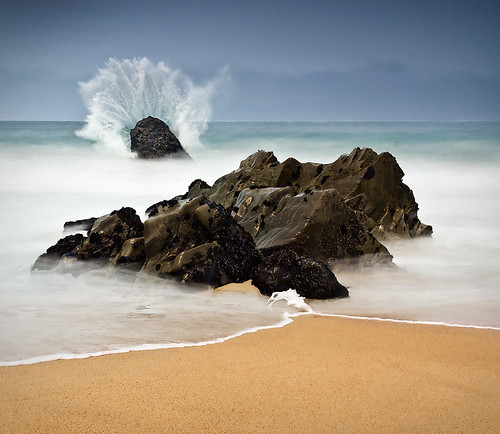
2) Capture Motion – With lower light and longer exposures comes the chance to capture the motion of the waves and sea. As you can see, this can really result in some haunting images that are ten different kinds of awesome.
3) Remember the Rule of Thirds – Composition of beach photos is just as important as any other type of photography. Remember to consider the rule of thirds and you shouldn’t go too far wrong with your beach composition.
4) Remember the Sunny F16 Rule – If you absolutely, positively must shoot at the beach when the sun in shining, then you might at least come away with some images worth looking at if you remember the sunny F16 rule. This is not an ideal situation, but if you are even remotely experienced with photography you will realise that there are very few ideal situations in this hobby and when they come up, you usually get a prize for the resulting images!
5) Take Advantage of Reflection – Being around so much water is going to give you a lot of opportunities to take advantage of reflection. If you need some inspiration then check out these reflection photos to see what we mean. Getting reflections under the right circumstances can add a huge element of interest to your images.
6) Don’t Ignore Black and White – While you may think of the water or beach as a place where you can get fantastic contrasting colours (and you would be right) you might also like to take a moment to consider black and white images. Some of the greats were able to get incredible black and white seascapes that ooze atmosphere. Look at this image for instance:
7) Use Driftwood in the Composition – You can find it on almost any beach and you can use it in good composition and to draw the viewer’s eyes to an area of the image. You can also move it around to build the image you want. (Ok, some people might consider that cheating, but we all do it!)
8) Think About the Weather – While the beach might provoke mental images of flawless cloudless days, more dramatic weather can result in incredible images at a beach. Look at the brewing storm in the image below to see what we mean or check out these storm photos to see what can be done when shooting in extreme weather.
9) Use Clouds for Drama – Going along with considering the weather is watching out for clouds. Most of the best images of beaches somehow incorporate clouds into the composition to add interest to the beach.
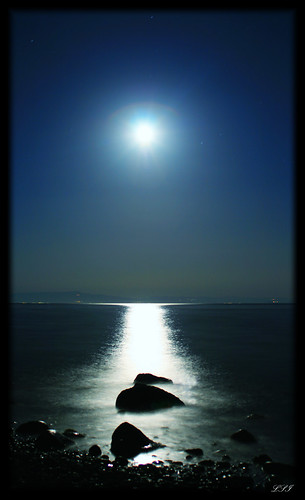
10) Don’t Forget Night Time – Beaches usually make us think about beautiful sunrises and sunsets. Don’t forget that you can get some spectacular night time beach photos too. There are a whole heap of separate issues in incorporating the moon into a photo but the results can be great. Check out our moon photos post to get some more inspiration.
Other Awesome Beach Photos
Concluding Thoughts
Shooting at the beach presents its own set of challenges with lighting, motion and composition. Even so, even a rudimentary adherence to some of the suggestions here should increase the chances that you’re able to capture an image a cut above most other beach photos. A bit of experimentation and deference to the conditions will mean you should come up with a couple of solid photos.
Since its origins, the IPCC has been open and explicit about seeking to generate a ‘scientific consensus’ around climate change and especially about the role of humans in climate change
I've been 'around' for a few years now, pursuing the shifting goal of a sharable home-made surfers resource site focused on ease of use and variety of mostly adult ( whoa : I didn't say prurient ) content.
 Image via Wikipedia

 Image via WikipediaENVIRONMENTAL IMPACT OF THE OIL AND GAS INDUSTRY’S CONSUMPTION OF WATER FROM THE ATHABASCA RIVER DURING THE PREDICTED WATER SHORTAGE FOR CANADA’S WESTERN PRAIRIE PROVINCES PDF











 Posts


